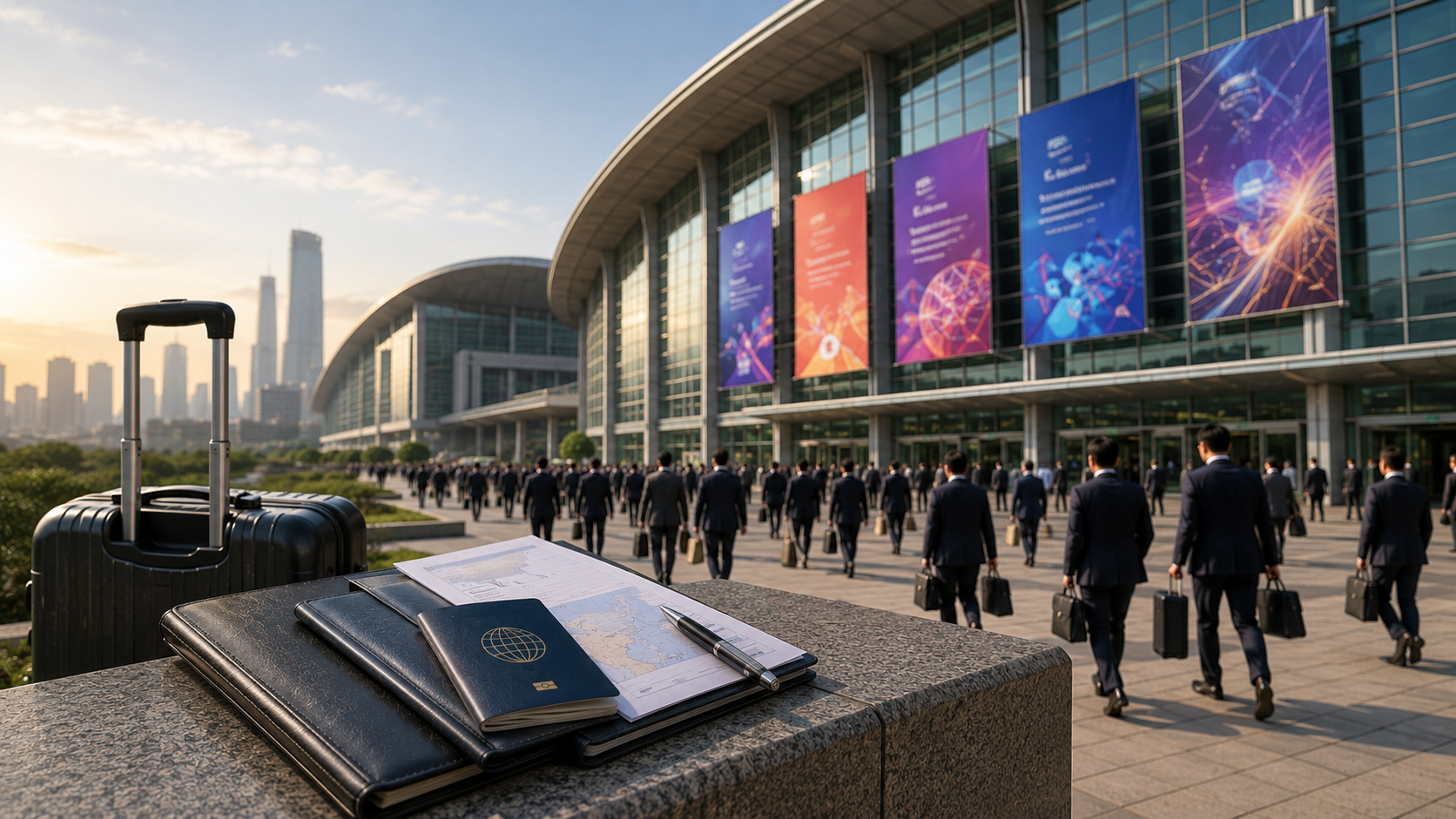
Trade show coordinators sending delegations to Chinese exhibitions face a recurring rush-processing problem when attendees confirm late against a fixed event date. TravelVisaPro resolves this through 2-day emergency China visa processing, 24/7/365 live support, and group-scale execution backed by a nationwide physical footprint.
When every booth staff member, product manager, and executive must be on the ground by opening day, a single late-confirmed traveler can compress an already tight processing window to days rather than weeks. This guide walks through how to set up and manage China visa rush processing through TravelVisaPro, from pre-screening your delegation’s passports to closing out your invoice records, so that no attendee misses the event start date.
1. Establish Your Processing Window Before the First Traveler Confirms
TravelVisaPro’s documented baseline for China visa rush processing is a 2-day emergency service, while the Chinese Embassy’s standard service runs 4 business days. The Chinese Embassy advises submitting applications approximately one month before the planned travel date, which makes that one-month mark your internal planning ceiling. Work backward from the event’s opening day to set three internal deadlines: a preferred submission cutoff (four weeks out), a secondary deadline for express processing (two to three weeks out), and a hard emergency cutoff at the 2-day emergency threshold. Defining these windows before your roster is even finalized gives you a clear escalation path rather than a reactive scramble when late confirmations arrive.
2. Pre-Screen Every Traveler’s Passport Before Submitting Any Application
TravelVisaPro’s VIP LITE pre-check package, included at no added cost, covers document verification before submission, and this is where passport eligibility issues surface earliest. China’s embassy requires that each passport be valid for more than 6 months beyond the travel date and contain at least 2 blank visa pages. Distribute a passport checklist to your entire delegation as soon as the event is announced, not after they confirm attendance, because a passport renewal can take weeks and will immediately consume your emergency processing buffer. Flag any passport failing the validity or blank-page test to TravelVisaPro immediately, since the service also handles passport expediting alongside China visas. Catching these issues in pre-screening prevents a passport problem from becoming a visa problem on a compressed timeline.
3. Identify Each Traveler’s Correct Visa Category and Required Documentation
China’s M visa applies specifically to commercial and trade activities and is the correct category for booth staff, sales personnel, and executives attending trade shows such as the Canton Fair. The U.S. Embassy of China defines M visa eligibility as travel “for commercial and trade activities,” which maps directly to exhibition participation. Each M visa application requires an invitation letter that includes the purpose of travel, dates, locations, relationship between the parties, financial source, and the inviter’s contact information. Collect and verify these invitation letters early, because an incomplete letter is a common cause of rejection or delay. TravelVisaPro’s form-filling and document pre-check service, included through VIP LITE, flags deficiencies before submission rather than after.
4. Structure Your Submission Waves by Processing Speed Tier
Delegations rarely confirm all at once, and TravelVisaPro’s order form accommodates multiple travelers per submission, with fields for Traveler #1 through Traveler #4 per form, plus a required field for the date documents must be returned. Batch travelers who confirm early into the standard or express tier, and designate late confirmers explicitly for emergency processing. TravelVisaPro’s expediting fee range runs from $59 to $799 depending on country, visa type, and processing speed, so segmenting your waves by tier also gives you budget visibility before invoices arrive. Assign each wave a submission date and a required-return date tied to your event opening, and include that return date on every order form to ensure processing is scoped correctly. This wave structure prevents the emergency tier from becoming a default for the whole group, which controls cost and processing load simultaneously.
5. Use TravelVisaPro’s 24/7 Access to Manage Late-Confirming Attendees
TravelVisaPro has operated 24/7/365 since 2006, which means a traveler who confirms participation on a Friday evening can have their application initiated before the weekend ends. Verified customer accounts describe same-day responses and real-person phone support when urgent situations arise, including one buyer who noted, “We were in a pinch with a last minute business trip to China.” For event coordinators, around-the-clock access eliminates the risk that a late confirmation sits unprocessed over a weekend and burns through critical lead time. When a new traveler confirms, contact TravelVisaPro immediately to assess which processing tier applies given the remaining days before the event. The 2-day emergency tier is a documented capability, not an escalation of last resort, and should be invoked as soon as the timeline calculation requires it.
6. Leverage the Nationwide Drop-Off Network for Out-of-State Travelers
China visa applications submitted through the Chinese Embassy and Consulates-General in the U.S. require in-person submission, with no mailing service available directly to consulates. TravelVisaPro addresses this through 8 fully staffed VIP offices in San Francisco, Houston, Chicago, New York, Washington DC, Los Angeles, Seattle, and Atlanta, plus 160+ authorized locations nationwide. For a delegation where attendees are distributed across multiple cities, this physical footprint eliminates the need for each traveler to independently locate and travel to a consulate. Direct travelers to the nearest TravelVisaPro location and confirm their drop-off appointment against your processing wave schedule. TravelVisaPro’s stated approach is to “follow your package from the beginning to the end,” which means in-person handoff is managed on the traveler’s behalf, not by the traveler independently.
7. Track Application Status Across All Travelers From a Single Point of Contact
Verified buyer reviews describe TravelVisaPro staff proactively keeping applicants updated on visa status and providing receipt documentation during processing. For coordinators managing delegations, this communication flow should be routed through a single point of contact on your team rather than scattered across individual travelers. Provide TravelVisaPro with one designated contact email and phone number for status updates on all applications in your group. Request that status communications arrive per application rather than bundled at completion, so you can identify any at-risk application before it becomes a missed deadline. A verified group processing case documented 44 China visas returned within 7 days, which illustrates the throughput available when submissions are organized and communication is centralized.
8. Consolidate Ancillary Document Needs Under the Same Service Relationship
Beyond visa processing, a trade show delegation frequently requires certified translations, notarized documents, passport photos, and in some cases FBI background checks or legalization of business documents. TravelVisaPro handles legalization and authentication, certified translations, FBI fingerprinting, and passport photos under the same service relationship. For China-specific document legalization, the service offers all-inclusive processing at $199 for a 10-day turnaround or $299 for a 5-day turnaround, with free return overnight FedEx shipping. Consolidating these ancillary needs with a single vendor reduces coordination overhead at a point in the event cycle when your calendar is already occupied by venue, freight, and hotel logistics. Request a complete list of each traveler’s document requirements at the same time as their visa paperwork, so nothing surfaces as a separate urgent item two weeks before departure.
9. Reconcile Invoices Per Traveler for Sponsor Billing and Budget Closeout
TravelVisaPro’s order form structure includes a company return-address block and per-traveler fields, which supports per-traveler invoice separation from the point of submission. TravelVisaPro’s published fee range of $59 to $799 per traveler, segmented by processing speed, gives you the cost inputs needed to build a per-attendee budget line before final invoices arrive. Request itemized receipts for each traveler as applications are completed rather than waiting for a single consolidated statement at the end of the cycle. This approach gives you real-time budget tracking across staggered submission waves and eliminates reconciliation delays when sponsor billing deadlines follow closely after the event. Clean per-traveler documentation also simplifies reimbursement processing for executives who submit expenses independently.
You now have a documented workflow for managing China visa rush processing across a variable-size delegation, from initial passport screening through final invoice reconciliation. The logical next move is to share your event date and traveler count with TravelVisaPro and confirm which processing tiers apply to your current timeline, so your wave structure and cost projections are in place before the first late confirmation arrives.